LacunnaLacunnaLacunnaLacunna
  • PORTFOLIO
  • Services
    • COUPLES
    • Weddings & elopements
    • INDIVIDUAL PORTRAITS
  • ABOUT
  • CONTACT
  • English
  • Polski
  • PORTFOLIO
  • Services
    • COUPLES
    • Weddings & elopements
    • INDIVIDUAL PORTRAITS
  • ABOUT
  • CONTACT
  • English
  • Polski
Portrait with flowers / Portret z kwiatami/ Ritratto con fiori
11/18/2020

Ilaria – Portrait with Flowers

  • Posted By : Anna Marcinkiewicz/
  • 0 comments /
  • Under :
Portrait with flowers / Portret z kwiatami/ Ritratto con fiori

Portrait with Flowers

Ilaria 🇮🇹

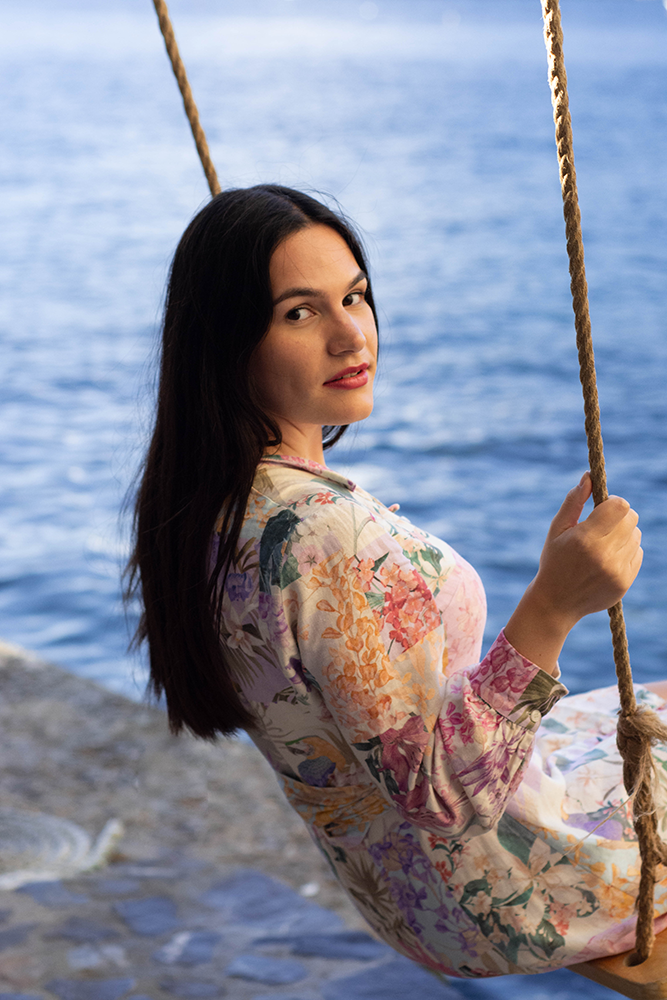
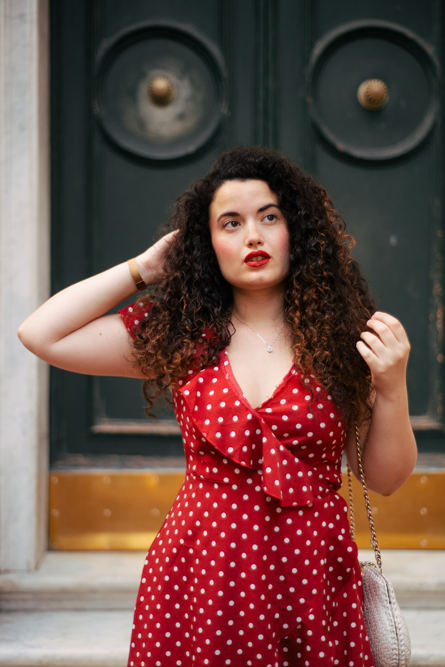
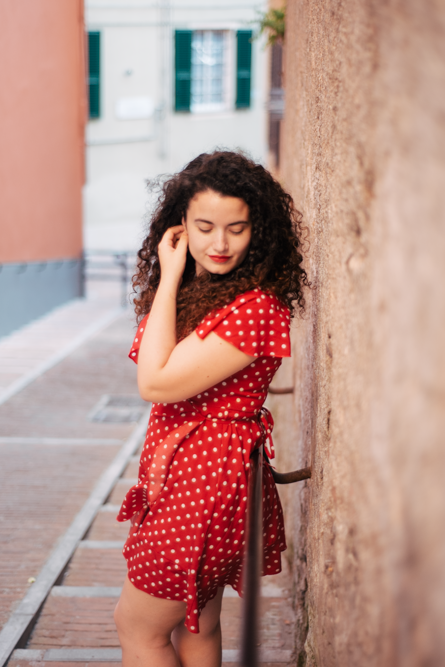
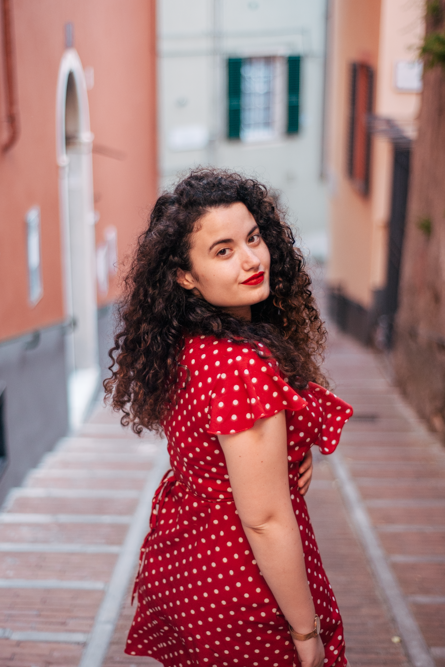
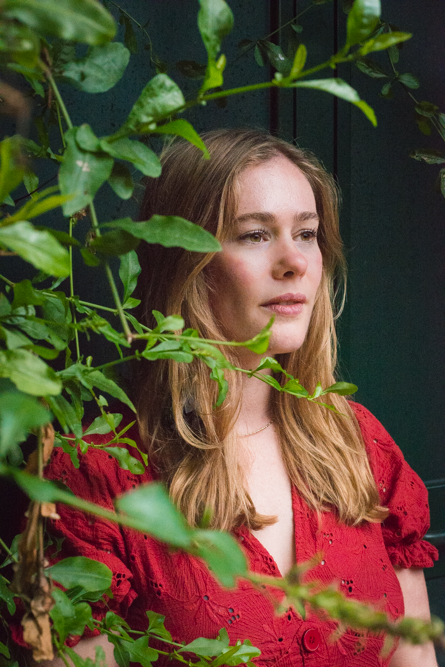
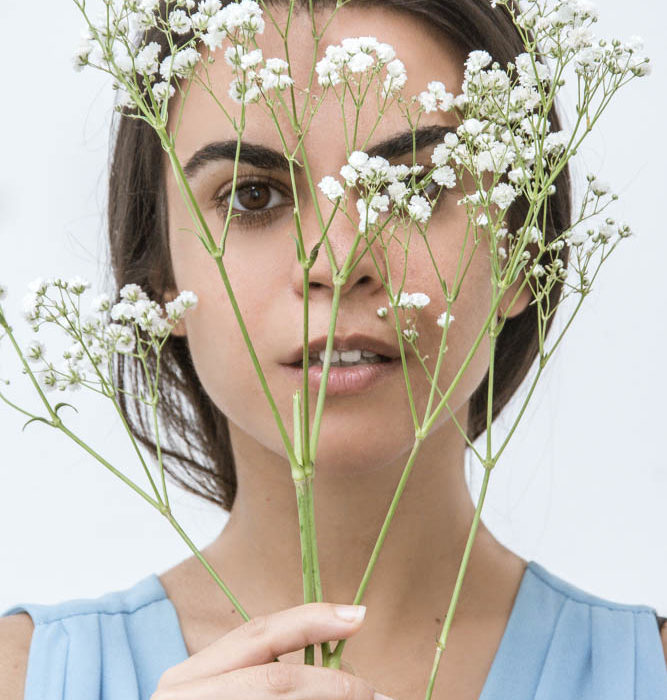
This photo session was inspired mainly by nature and femininity. The portrait with flowers became the perfect answer to the next lockdown, longing for nature and the upcoming winter. The idea of ​​photos also refers to the language of flowers, the symbolism of which has always fascinated me. Probably each of us knows that red roses mean love and white lilies signify purity. But in fact, each flower has a hidden message for us.

Language of Flowers

The symbolic meaning of flowers has been present in culture for centuries – adapted from classical mythology, religious symbolism and ancient tradition. However, it was Louise Cortambert (pseudonym Madame Charlotte de la Tour) that defined the cryptologic language of flowers by writing her dictionary Le langage des Fleurs (19th century). Her book conquered mainly France, England and the United States, as well as other European and South American countries.

The Victorian era (Great Britain, 19th century) was particularly fond of the secret language of flowers. At a time when direct expression of affection was unwelcome, floral arrangements became intercessors of hidden messages. The “talking bouquets” were called nosegays 1 or tussie-mussies. They were often part of clothing – they were kept close to the nose, used as a brooch, hair ornament, or tied around the waist. Interestingly, the idea of ​​wearing bouquets on clothes has a much less romantic origin. Flowers and herbs placed close to the nose was a way to deal with plagues and the unpleasant smell of dirty cities. Nowadays, tussie-mussie has survived as a popular wedding accessory.

Ilaria & Alstromeria

We chose flowers for the session together with Ilaria, guided by our intuition. All in very feminine tones of white and pink. I checked their meaning afterwards. It turned out that they perfectly match Ilaria’s personality and convey a very interesting message:

  • Alstroemeria – Sacrifice⁠⠀
  • Eustoma – Recognition⁠⠀
  • Gerbera – Joy⁠⠀
  • Gypsophila – Infinite love⁠⠀
  • Pink Carnation – I will never forget you⁠⠀

I decided to complete the portrait with flowers with pictures of frozen alstroemeria. The abstract, watercolour effect of the close-ups is the perfect addition to the entire gallery.

If you are curious about the meanings of other flowers, you can use this dictionary. I also invite you to contact me for flower photo sessions and to see the other portrait gallery.


Annotations:

1 The Middle English word “gay” meant ornament.

Żyrardów – Garden City
Bologna – The Red City

architektura bolonii włochy architecture of bologna italy lacunna anna marcinkiewicz
07/10/2020

Bologna – The Red City

  • Posted By : Anna Marcinkiewicz/
  • 0 comments /
  • Under :
Architecture of Bologna / Architektura Bolonii / Architetture di Bologna
architektura bolonii włochy architecture of bologna italy lacunna anna marcinkiewicz
Architecture of Bologna / Architektura Bolonii / Architetture di Bologna
architektura bolonii włochy architecture of bologna italy lacunna anna marcinkiewicz
Architecture of Bologna / Architektura Bolonii / Architetture di Bologna
architektura bolonii włochy architecture of bologna italy lacunna anna marcinkiewicz
Architecture of Bologna / Architektura Bolonii / Architetture di Bologna

Architecture of Bologna

The Red City of towers and porticos

Mediaeval conflict between secular and spiritual authority had a great impact on the city. Papacy, emperor and Italian city-states were involved in the outside strife. While the Ghibellines (supporters of the empire) and the Guelfs (supporters of the papacy) fought internally. Bologna used to pass from hand to hand many times, as a part of the State of the Church or as a city of the Lombard League. Turbulent history caused construction of many defensive buildings. Whereas resilient development of a Mediaeval commune (12th – 14th century) resulted in demographic growth. Urbanism of the growing city presented a challenge. The independent city was supporting its economy by using local materials, such as selenite1, clay or oakwood. Under the influence of these circumstances, architecture of Bologna formed its characteristic features.

The Two Towers … for a living

In the 12th and 13th century Bologna had to look like a Mediaeval version of Manhattan. In this period, there were around 100-180 residential towers. It is easy to guess that the buildings served as an accommodation and a place of defence. In this way, rich families were protecting themselves against local and outside conflicts.

All the towers were built according to a similar scheme.The structure, raised on pile foundations, had a plan similar to a square. The base was made of a local material – selenite. The representative ground floor connected the upper floors only with easily removable stairs, which were removed in the event of an attack. Thereby households were hiding from the enemies on the higher part of the tower. Lighter construction of rubble masonry2 was applied above the base. A space between double, brick-built walls was filled with hardcore, stones and lime mortar. The thickness of the wall decreased towards the top. Characteristic square holes in the structure served to fix a scaffolding. Dark and narrow towers were not a perfect place to live. With time, they become just a symbol of richness in the race for the highest building.

To make better use of the limited space of the growing city, the towers were demolished or adopted to public functions (e.g. jails or shops). Just 20 of them survived until today. The most famous Two Towers of Bologna are Asinella (97.2 m high) and its crooked neighbour Garisenda (48 m high, 3,2 m angled). We can even find mention of the latter in Dante’s Divine Comedy.

As when one sees the tower called Garisenda
from underneath its leaning side, and then a cloud
passes over and it seems to lean the more,
thus did Antaeus seem to my fixed gaze
as I watched him bend. 3

La Rossa – The Red City

The nickname of Bologna – La Rossa (The Red) is mostly associated with the resistance movement and Italian Communist Party. However, the history of this colour is much older. In the 12th century the independent city placed importance on local resources – clay (bricks and terracotta), selenite, sandstone and oakwood. Natural red hue of the raw materials, especially these made of clay, accented an independence from the Pope (represented by white colour). Terracotta – it. terra cotta means literally “baked earth”. It was used mostly as material of decorative elements for example sculptures, tiles, slates or gutters (sima). Also, many buildings have a characteristic finish of walls. Sagramatura is a technique in which lime plaster with pigments covered the brick in such a way as to preserve the texture of the wall. The best examples of the mentioned decorations are renaissance palaces Palazzo Bolognini Amorini Salina and Palazzo della Mercanzia.

Neo-Gothic architecture of Bologna also referred to mediaeval materials and colours. In this way, for ages, red dominated the historical centre of the city. Nowadays, to prevent consistency and colour scheme, the city introduced the regulations called  “Piano di Colore”4. The rules define all acceptable hues of red that are allowed on elevations.

Limitless portico5

By the end of the 13th century Bologna was in the top ten most populated cities of Europe – around 50 000 citizens. There was not enough space for such a population. A difficulty was that wooden structure of buildings hindered upper extensions. Narrow streets limited the width of the houses. Moreover, property tax was dependent on the size of the ground floor. But smart Bolognesi found a way to solve this problem. To increase the space of the building, they started to build light, wooden construction in front of the main facade, but starting from the first floor. Initially the structures had a form of a bay window6 or covered terrace. Very fast, the citizens understood that they can increase the construction even more by supporting columns on the base floor. In this way bay windows transformed into porticos.

Covered passages also had extra advantages – protection from the sun and rain. The city authorities appreciated the usefulness of porticoes, so in 1288 they ordered their construction in front of every house. The regulations determined a minimum height around 2,66 m – a size of a man with a hat sitting on a horse. Nowadays porticos in Bologna have a total length of 38 km. One of the most famous passages starts from the city gate Porta Saragozza and leads to the sanctuary of  Madonna di San Luca. The fun fact is that it has exactly 666 arches.

Your next stop in this architectural journey around the city should be  Sfolia Rina, where I have tried the best designed ravioli. Also I would like to thank Giulia, who answered with great enthusiasm for all my questions about the city.

Travel Palette of Bologna
Persimmon
Saffron
Terracotta
Sienna

Annotations:

1Varieties of gypsum, known also as a moonstone.
2Rubber masonry – it. muratura a sacco, la. opus coementicium.
3Divine Comedy, Inferno, XXXI, 136-140. Translation by Robert Hollander and Jean Hollander.
4Piano di Colore – it. colour plan.
5Portico – la. porticus “colonnade, covered passage”. Open part of the base floor limited by at least one row of columns, which support upper levels or roof.
6Bay window is a protruding part of the main elevation, with a separated roof, that starts from the level of the first floor.

Ilaria – Portrait with Flowers
Paris - The City of Light

Paris - City of Light / Paryż - miasto światła / Parigi: la città della luce
05/31/2020

Paris – The City of Light

  • Posted By : Anna Marcinkiewicz/
  • 0 comments /
  • Under :
Paris - City of Light / Paryż - miasto światła / Parigi: la città della luce

Paris The City of Light

Best illuminated European city or capital of the Age of Enlightenment?

Paris – the City of Love. It is the first association that comes to our mind. However, etymology is more mundane. The name of the city does not derive from the Trojan prince (and lover) Paris. It came from the Celtic tribe Parisii that used to live in this area. Personally, there is another alias of the city that I find more exciting: Paris – the City of Light (La Ville Lumière). It refers literally to urban illumination but also to the Age of Enlightenment (the Age of Reason).

Enlightment

One of the most important ideas of the age are: primacy of  reason (rationalism, humanism), exclusivity of natural laws and forces (naturalism) as well as transformation of social, religious and political life (reformism). The City of Light played an important role in this period. The Age of Reason began (1715 – death of Louis XIV) and ended (1789 – outbreak of the French Revolution) in Paris. This is precisely where Diderot and d’Alembert published the first encyclopaedia. Montesquieu was promoting the theory of separation of powers. And Voltaire canvassed for rational thinking, liberalism and tolerance. Speaking about architecture from this period, it is noticeable that time frames are less precise and ideas are not that clear-cut. In the time of the Enlightenment, we are able to distinguish two totally different styles – Late Baroque (also known as Rococo, 1675 – 1750) and Neoclassicism (1760 – 1830).

French Architecture of 18th Century

Baroque is one of the most decorative architectural style. Full of theatricality, gold-plated details reflected in mirrors as well as dramatic light contrasts on rotund forms. As if it were not enough, Rococo brought even more ornaments. Surprisingly, the style did not lose its lightness. A spectator can be overwhelmed by splendour but definitely not by heaviness of forms. The style impacts our sensuality in a sentimental and sly way. An iconic example of the French Baroque is Palace of Versailles with its stunning Hall of Mirrors.

A successive style – Neoclassicism was a better representation of the the Enlightenment’s theories. Archeological research of Herculaneum and Pompeii1 became an impulse of a throw-back to classical architecture of Ancient Rome and Greece. Also great minds of this age (like D. Diderot, J. J. Rousseau) were promoting simplicity and antique values, determining a way forward of art. Thus, purist forms straight from Ancient Rome and Greece replaced exaggerated Baroque decorations. Monumentalism and harmony of the buildings was brought out by rhythmic columns and a symmetric plan. Balanced amount of ornaments lent elegance and dignity but did not resort to minimalism. In Paris, the most well-known examples are Arc de Triomphe and Pantheon. The new style was also implemented in the Palace of Versailles – Petit Trianon2 and Belvedere3.

Louvre Palace is an interesting comparative example. It has elevations in both of the above-mentioned. Western (inner) facade of the Cour Carrée – Pavillon de l’Horloge (Clock Pavilion) is baroque. Eastern (outside) facade of the Cour Carrée – Colonnade de Perrault has a typical classical style. You can find the scheme of the museum plan here.

Illumination

An evening walk along the Elysian Fields or view for the night illumination of the Eiffel Tower (20 000 light bulbs!), is enough to notice an important role of artificial lighting in the identity of the place. Paris – the City of Light was one of the first European cities with gas street lighting on a big scale (1829). Around thirty years later, the number of the lamps increased to 56 000.  Nowadays, there are 296 buildings and 33 bridges with special illumination. It is no wonder that Paris by night is full of life.

Moreover, I pointed out natural lighting conditions during the day. In November the city had an elegant, opaque light in a dove-grey hue. Soft colours of cloudy sky and monochromatic town-houses were in contrast with sharp angles of dark mansards4. Deep tones of autumn trees were representing the last energetic points of summer. Maybe, except for permanently crowded bars. To be honest, I really liked this sentimental version of Paris.

Travel Palette of Paris
Gold
Ecru
Powder Blue
Prussian Blue

Annotations:

1Herculaneum and Pompeii were two ancient cities in Italy, destroyed by volcanic eruption of Vesuvius (79 AD).
2Petit Trianon – Small Trianon is a small château, built in the Versailles garden for the king’s mistress Madame de Pompadour.
3Belvedere (from Italian for “fair view”) – a garden building in the form of pavillon, terrace or open gallery that has a scenic view for particularly interesting composition or viewing axis. Because of that it was mostly located on a hill.
4Mansard – living compartment in the attic. In this case the roof has a specific two-slope shape. An upper part is more flat (small pich). A lower part is almost vertical. The roof cover is also part of the facade of the last level.

Bologna – The Red City
Azores – São Miguel

São Miguel Island - Azores Archipelago / São Miguel - wyspa archipelagu Azorów / São Miguel - Isola dell'arcipelago delle Azzorre
02/23/2020

Azores – São Miguel

  • Posted By : Anna Marcinkiewicz/
  • 0 comments /
  • Under :
São Miguel Island - Azores Archipelago / São Miguel - wyspa archipelagu Azorów / São Miguel - Isola dell'arcipelago delle Azzorre

Azores

Unknown Island – São Miguel

Ponta Delgada is the biggest town on the Saint Michel Island (São Miguel). It fulfils a function of the Autonomous Region of the Azores capital as well. Other eight islands of the archipelago have equally interesting names: Flowers, Crow, Beech, Peak, Saint George, Charming, Third, Saint Mary (pt. Flores, Corvo, Faial, Pico, São Jorge, Graciosa, Terceira, Santa Maria). It was February. The sun used to appear rarely. Because of that, we were celebrating this moment, having breakfast on a driveway of a rented guest house. With an additional hour1 we stopped our inner rush. There were nine of us but everybody had its own space of the isolation. We have been discovering places independently until we were imbued with sky, earth and water. Unknown Island belonged to us for a moment.
Sky

A bird was circling above our heads. Maybe it was a hawk, that had been seen by the sailors of Henry the Navigator? Portuguese rediscovered islands in the 15th century and the name of the archipelago probably comes from the word açor (pt. hawk). Famous Azores High was bringing us rain and wind spontaneously. During the day our vision was escaping beyond the horizon, through undiscovered layers of mist. A far-sightedness was disappearing in the deep darkness of the night. All that mattered was in the range of the lamp’s light – table and us.

Earth

São Miguel could not hide its origin. Even if craters of extinct volcanoes are filled with water. They resembled oval mirrors and allowed us to see a double universe in all water tables. The black sand of coast was passing through  the ocean’s hourglass. The only European tea plantations Chá Porto Formoso (since 1878) and Chá Gorreana (since 1883) were basking in the sun. Amber colour of the drink matched perfectly the tones of the sunset.

Water

It was still possible to feel the warm breath from the centre of the earth. Furnas (pt. cave), Fogo (pt. fire) and Sete Cidades (pt. seven cities) are three zones of volcanic activity, harbouring hot springs and geysers. In the complex of Terra Nostra red water2 of a swimming pool contrasted with the lacklustre greenery of a botanic garden. Hot springs in Caldeira Velha looked totally different – lush green vegetation was everywhere, like in a tropical jungle. Our bodies were melting in warm water until they became inert3.

Madeira or Azores? If you would like to know more about the Portuguese islands – check out other gallery about Madeira.

Travel Palette of Azores
Cerulean
Sap Green
Hooker’s Green
Anthracie

Annotations:

1In winter Azores has UTC -1 time zone, there is one-hour difference compared to Portugal (UTC+0) and two hours compared to Poland (UTC+1).
2Orange colour of the water is caused by a high content of minerals.
3Water temperature in Terra Nostra – 35-40 Celsius. Water temperature in Caldeira Velha – 20-34 Celsius.

Paris - The City of Light
Madeira - Eternal Spring Island

Madeira, the island of eternal spring / Madera wyspa wiecznej wiosny / Madeira, l'isola dell'eterna primavera
01/18/2020

Madeira – Eternal Spring Island

  • Posted By : Anna Marcinkiewicz/
  • 0 comments /
  • Under :
Madeira, the island of eternal spring / Madera wyspa wiecznej wiosny / Madeira, l'isola dell'eterna primavera
wyspa madera madeira island lacunna anna marcinkiewicz
Madeira, the island of eternal spring / Madera wyspa wiecznej wiosny / Madeira, l'isola dell'eterna primavera
wyspa madera madeira island lacunna anna marcinkiewicz
Madeira, the island of eternal spring / Madera wyspa wiecznej wiosny / Madeira, l'isola dell'eterna primavera
wyspa madera madeira island lacunna anna marcinkiewicz
Madeira, the island of eternal spring / Madera wyspa wiecznej wiosny / Madeira, l'isola dell'eterna primavera
wyspa madera madeira island lacunna anna marcinkiewicz
Madeira, the island of eternal spring / Madera wyspa wiecznej wiosny / Madeira, l'isola dell'eterna primavera
wyspa madera madeira island lacunna anna marcinkiewicz
Madeira, the island of eternal spring / Madera wyspa wiecznej wiosny / Madeira, l'isola dell'eterna primavera
wyspa madera madeira island lacunna anna marcinkiewicz
Madeira, the island of eternal spring / Madera wyspa wiecznej wiosny / Madeira, l'isola dell'eterna primavera
wyspa madera madeira island lacunna anna marcinkiewicz
Madeira, the island of eternal spring / Madera wyspa wiecznej wiosny / Madeira, l'isola dell'eterna primavera
wyspa madera madeira island lacunna anna marcinkiewicz
Madeira, the island of eternal spring / Madera wyspa wiecznej wiosny / Madeira, l'isola dell'eterna primavera

Madeira

The Island Of Eternal Spring

The Autonomous Region of Madeira is a Portuguese archipelago in the Atlantic Ocean, including the islands of Madeira, Porto Santo, Ilhas Desertas (pt. desert islands – 3) and Ilhas Selvagens (pt. wild islands – 19). Most of them are uninhabited, and this, in my opinion, makes them even more evocative. I stayed in the Madeira between February and March. In 2014 it was the period of carnival. I was travelling with two friends and we have been very lucky. Alberto – the owner of our hostel (Residencial Funchal) has been organising private guided tours around the island. Thanks to that we were able to see everything with the eyes of Madeiran.   

Sun

At the end of the day, Alberto took us to Porta do Sol (pt. Gate of The Sun) to see the sunset above the ocean. We were watching it in silence.
“We do not need money, the sun is our gold,” he said after a moment of reflection.

Indeed, not without a reason, Madeira is called the land of eternal spring. For a person who came here directly from the middle of the Polish winter, contrast was really huge. On the farmer’s market, it was hard to guess the names of some fruits and vegetables. On the plantation, I saw banana flower for the first time. We jumped over the fence just to see it closer. I also got to know how to eat fresh passion fruit – smushed pulp should be sugared, to get rid of the acid taste. Wine is not the only drink Madeira is famous for. Fruity cocktails perfectly represent the flavours of the island. Sweet Poncha – aguardente<sup>1</sup> mixed with lemon juice and honey (or sugar cane molasse) or Niquita – white wine, pineapple and vanilla ice cream.

Paradise on Earth

We were walking along the harbour of Funchal. An elegant waiter stopped us to show the menu and started a little chit-chat. He was curious about where we came from. Poland seemed to be a very faraway country.
 Poland seemed to be a very faraway country.
“We do not need to leave this island, we have paradise here,” the waiter said confidently. 
Madeira in Portuguese means wood. The name was given by discoverers of the archipelago2. Temperature and humid air were hiding the land in the mist. After a moment everything was filled with sunlight and shining in all tones of green. Dynamics of these changes contrasted with static mountain tops and little villages, hidden in the valleys. Volcanic origins of the island were particularly visible at the seaside. Black rocks and sand created natural marine swimming pools (like the one in Porto Moniz). Irrigation channels that are going through mysterious laurel forests are called levadas. Water transported from north of the island is watering its southern parts. Former service pathways along the channels are currently used as tourist trails. I felt like a discoverer of a new world when I was following one of them – Caldeirão Verde. In the end, a mystical waterfall (around 100m high) arose before our eyes.  

Saudade

One evening we were trying to find a fado3 concert in Funchal. Traditional Portuguese music is really melancholic and tells about ‘saudade’ – gratitude and longing for things that happened in the past. There was no place to sit but the owner of the venue , allowed us to listen to it from the porch. Guests were sitting between the musicians (Portuguese guitar and vocal) in the half-light.
“This restaurant is our family business. Today one of our members died, but we had no choice, the show must go on”, the owner explained in a whisper.
A girl singing in the middle of the room had tears in her eyes. Fado music has never been more meaningful than that day.

Travel Palette of Madeira
Ochre
Phthalo Green
Indigo Dye
Azure

Annotations:

1An alcoholic beverage distilled from wine. The name means “burning water”.
2 First pieces of information about the archipelago came from Phoenicians. Portuguese sailors João Gonçalves Zarco and Tristão Vaz Teixeira discovered the island Porto Santo.
3 A genre of music called Portuguese Blues.

Check out our (funny) movie from the island in a rhythm of Happy by Pharrell Williams.

Azores – São Miguel
Genoa

photography of Genoa / fotografia Genui / fotografia di Genova
05/27/2019

Genoa

  • Posted By : Anna Marcinkiewicz/
  • 0 comments /
  • Under :
photography of Genoa / fotografia Genui / fotografia di Genova

Genoa

The endless city of Janus1 with two faces

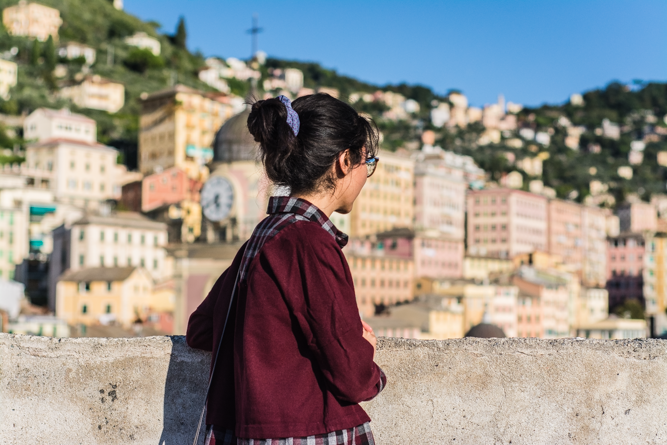
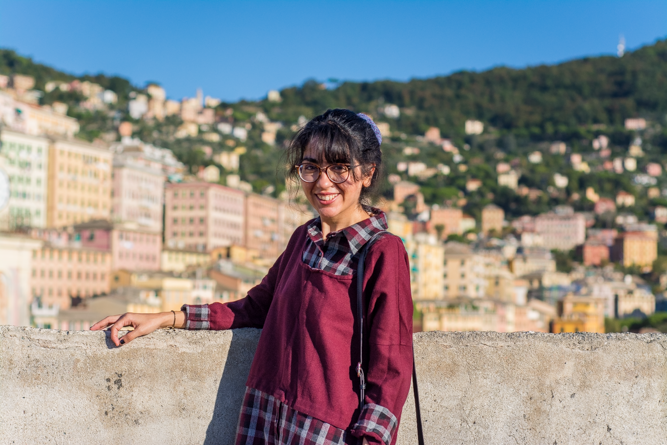
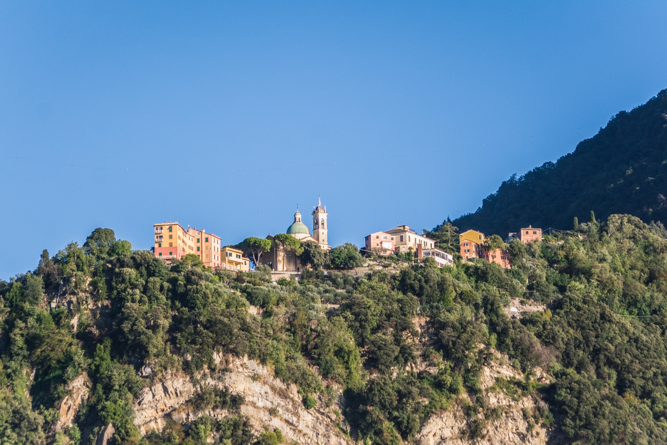
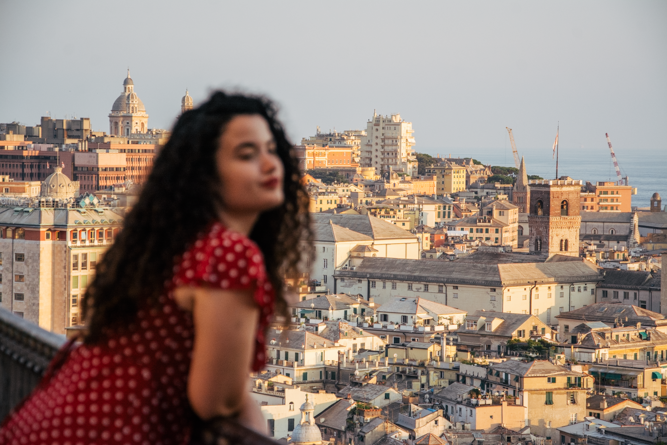
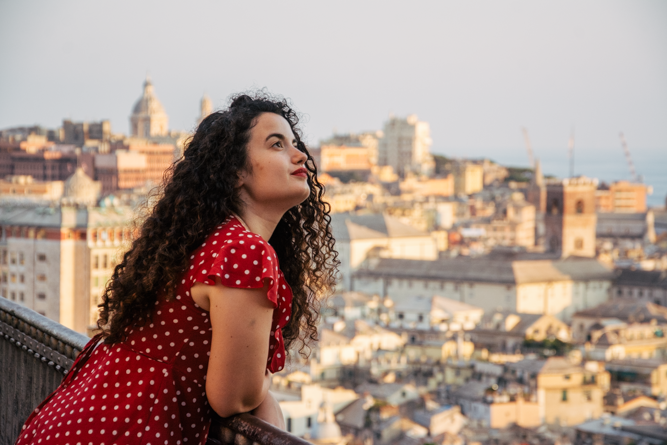
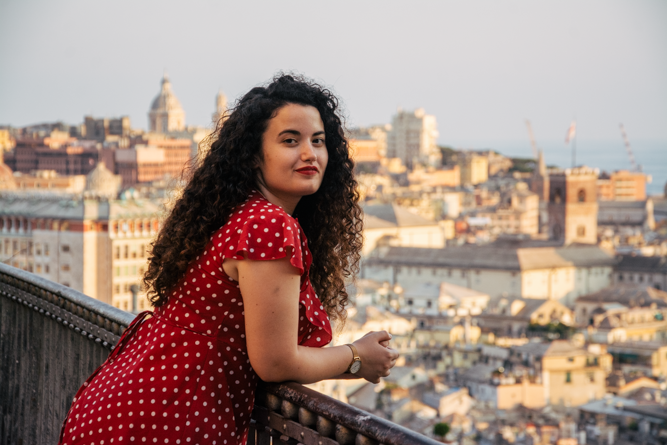
Massive Genoa (Italy) seems to be immovable. Horizontal, white-green stripes of facades pull down, widen optically, but anyway everything is vertical. Mountainous frontages of the residences on Le Strade Nuove2 are hiding secret gardens and elegant yards. High windows are tightly closed with shutters – even light cannot glimpse the private space of inhabitants. Italian architect Renzo Piano built an aquarium in a port. Marine creatures from around the world are kept there – they do not threaten successors of Columbus3 anymore. A sea is the only one border, Genoa is spreading, expanding and accumulating in a multilevel way. It is necessary to look from a distance to see everything.I felt that I was shrinking and vanishing, that I needed someone who would lead me by the hand.

Boccadasse

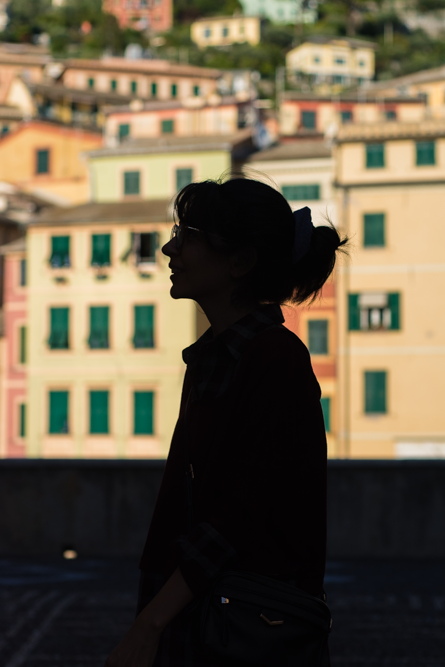
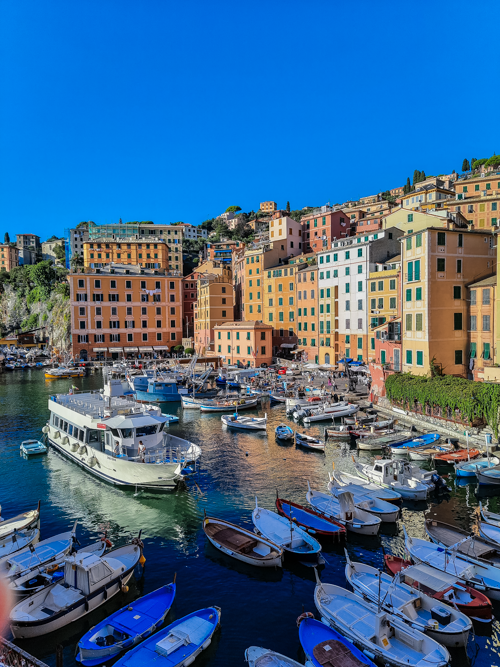
On Corso Italia, someone pours sunlight every day, which slows down steps and causes drowsiness. One should close eyes and walk half dreaming until the end. On the edge – an antique borgo Boccadasse (it. bocca d’asino – donkey’s mouth) – the old marine neighbourhood with remarkable Italian architecture. A little harbour opens its mouth to taste salty waves. Simple, nestled houses have loud colours and smell like a sea. They do not fit la Superba4, so they are hidden behind the corner.

Nervi

Is it possible that the district was a Celtic colony? Probably. Its name came from the motto ‘near av inn’ – a place near the sea. The suspended between cliffs promenade Passeggiata Anita Garibaldi5 leads to a calm port under the attack of waves. Maybe it still remembers humble beginnings of the daily route of fishermen and farmers? Or glory days, when rich nobles used to build their summer residences (Villa Gnecco, Villa Gropallo, Villa Luxoro, Villa Saluzzo Serra, Villa Grimaldi Fassio)? The growing settlement, with time, absorbed parks of the maritime villas. The remaining parts of the gardens were combined into the botanical complex Parchi di Nervi. Local people do not speak too much. Maybe because their voices drowned in the sea.

Travel Palette of Genoa
Cobalt Blue
Grey
Naples Yellow
terracotta

Annotations:

1 The god of motion (beginnings and endings) has, according to his dual nature, two faces. The legend says that he was the founder of Genoa – and like him, the city also has two faces, one heading sea, other mountains.
2 UNESCO World Heritage Site Genoa: Le Strade Nuove and the system of the Palazzi dei Rolli.
3 The Italian explorer was born in Genoa.
4 it. la Superba – the proud one
5 Wife and comrade-in-arms of Italian general Giuseppe Garibaldi who united Italy.

Madeira - Eternal Spring Island
Architecture of London

architecture of London / architektura Londynu/ architettura di Londra
04/21/2019

Architecture of London

  • Posted By : Anna Marcinkiewicz/
  • 0 comments /
  • Under :
architecture of London / architektura Londynu/ architettura di Londra

Architecture of London

The city of mirrors through my lens

In the foreground, the architecture of London attacks with clocks. As befits the bustling capital, time plays a very important role here. Or maybe more of a lack of it? A stream of rushing people grabs you and carries you deeper into the city. Sometimes it feels like it’s also time travel. Another strong accent is the colour red, which energises us into a state of alert. However, its influence is strangely not vulgar and flashy – you know – keeping English manners first.

Subsequently, glass skyscrapers. If you do not get lost in the left-hand rise, it is possible to notice that a new city is reflecting the past. The modern, glass architecture of London reflects its history. Glass has become one of the most popular materials in contemporary design. Reflective facades enhance the mirror effect, creating a parallel reality. Elements of urban space are not physically connected. Centuries-old buildings are visible in every piece of glass facades. They look a bit like elegant old-school gentlemen who do not flaunt their presence, hiding in the shadow of modernity, but still exude their charm.

Background: repeating signs. Modest facades of terraced houses politely wait for their owners. The subtle scent of green tea and coffee fills the café space but never goes out onto the street. The promise of rain and grey smog hangs in the air. This is how it should be – the last plan highlights only the main characters, remaining unitary, modest and grey.

You are at the end of it all – just a visitor, with a kind invitation to admire the city. Don’t be fooled, you’re not the observer here. It’s London watching you from behind the two-way mirror of facades. Enjoy your visit!

Travel Palette of London
Platinum
Powder Blue
Gunmetal
Scarlet
Genoa
Easter in Spain

Easter in Spain / Wielkanoc w Hiszpanii / Pasqua in Spagna
04/08/2019

Easter in Spain

  • Posted By : Anna Marcinkiewicz/
  • 0 comments /
  • Under :
Easter in Spain / Wielkanoc w Hiszpanii / Pasqua in Spagna

Pascua

The outstanding celebration of Easter in Spain1

Celebration of Easter in Spain lasts from Palm Sunday until Resurrection Sunday. The tradition of processions2 comes from the 14th century and is popularized especially in Andalucia.

Procession

The procession has a particular order. Black dressed women inaugurate the march. Their veils and decorative metal or pearl crests symbolize respect for the death. A guiding cross and silent Nazarenes3 come after them. Their penitential ceremonial with characteristic peaked hoods dates back to the medieval robe of the Inquisition’s convicts. They have particular tasks: Nazarenos de Fila march next to an altar, Nazarenos de Luz carry blessed candles and Penitentes wooden crosses. The old altar on the platform, which represents scenes from Passion. It weighs about 200 kg and is carried by around 50 men4, who change at every stop. Bearers are invisible, so it seems that the altar is moving on its own. A marching band follows the platform and gives rhythm to the march. The Nazarenos close the entire procession. Citizens and tourists fill to the brim streets, balconies, windows … and often bars.

Contrasts

Easter in Spain has impressed me. Mainly because of an omnipresent contrasts. Silent procession and sombre rhythm of drums blend into happy chatter from the bars. Costumes of the Nazarenos are scary, despite intensive colours.Penitents – Spanish beauties – are marching proudly in elegant dresses, but smoking cigarettes around the corner. Incenses are mixing with the smell of food. Crucified Jesus moves with the crowd on sun-drenched streets. The procession plays its role behind the curtain of dignity, anxiety and sublimity. It crosses lively streets in silence and disappears like a phantom. The crowd merges with it like the Red Sea5. Still, the sound of drums stays inside the head, long after the procession is gone.

The photographs were taken in Grenada, Malaga and Sevilla in 2015.
More information on Spain’s Official Tourism website.


Annotations:

1es. Semana Santa
2es. procesiones
3es. Nazarenos
4es. Costaleros
5Exodus of Jews from Egypt and crossing the Red Sea

Architecture of London
Self-portrait

street art of Portugal / street art Portugalii / street art del Portogallo
03/31/2019

Self-portrait

  • Posted By : Anna Marcinkiewicz/
  • 0 comments /
  • Under :
street art of Portugal / street art Portugalii / street art del Portogallo

Self-Portrait

Sentimental street art of Portugal

What do we think about people from sunny Portugal? Cheerful, easy-going Southerners? However, the vibrant street art in Portugal vividly portrays their dynamic personality in a totally different way. The excerpt from a piece by the Lisbon poet cited below also reveals the rather melancholic and introspective character of Portuguese individuals.

Álvaro de Campos
The tobacconist

I am nothing.
I shall always be nothing.
I can wish to be nothing.
That apart, I have in me all the
dreams of the world.

There is a word in Portuguese, which cannot be translated directly into any other language – saudade. If you have ever felt simultaneous longing for a past moment and gratefulness for what has happened to you, it was saudade. The feeling was accompanying discoverers who sailed away to look for new worlds. Families waiting for their return. Fado1 musicians from Alfama. Fernando Pessoa2 with his numerous personalities. Returning emigrants from the former colonies, who lost their estates. Victims of António de Oliveira Salazar’s regime3. The Portuguese sun outshines emotions, but saudade is written on the urban walls and doors in a very particular way. Therefore, the street art of Portugal reflects a not so obvious influence of history and subtle features of citizens’ characters, including a sense of longing, gratitude, dynamism, introspection, vibrancy, historical resilience, emotional depth, and cultural richness.

Graffitis’ text translations
  • Contento-me com pouco, mas desjo muito.
    A few things are making me content, but I desire a lot.
  • Abre los olhos.
    Open your eyes.
  • O Senhor, filho de Lisboa.
    Sir, son of Lisbon.
  • Quando for grande, quero ser feliz.
    When I grow up, I want to be happy.
  • Sozinhos vamos rapido, juntos vamos longe.
    Alone we go fast, together we go far.

Annotations:

1A genre of music called Portuguese Blues.
2One of the most prominent Portuguese poets, who used numerous pseudonyms.
3Portuguese statesman, Prime Minister, responsible for the New State (pt.Estado Novo) – an authoritarian government until 1974.

Easter in Spain
Lisbon

lisbon's urban planning / urbanistyka Lizbony / urbanistica di Lisbona
03/19/2019

Lisbon

  • Posted By : Anna Marcinkiewicz/
  • 0 comments /
  • Under :
lisbon's urban planning / urbanistyka Lizbony / urbanistica di Lisbona

Lisbon’s urban planning

Earthquake resistant architecture

Is it possible that one day can change Lisbon’s urban planning? History of Lisbon shows an unusual metamorphosis, which can be seen in still existing districts Alfama and Baixa. The solutions implemented after the Great Lisbon Earthquake had a huge impact on the architecture of Portugal.

Alfama

The name of the oldest Lisbon neighbourhood came from an occurrence of mineral springs – an Arabic word Al-hamma meaning fountains or baths. But it is not the only one testimony of its origins. It was established by Maurs1 on the slope of the Tagus River. An urban plan imitated an unconquerable maze, which was a characteristic feature of Maghreb2. Narrow, steep streets hindered attacks on the contemporary city centre – citadel Castelo de São Jorge3. However, high-density housing had a negative impact on the sanitary and living conditions. That’s why the poorest people and fishermen lived in the area. Thanks to the high location, Alfama was the only survivor from the earthquake.    

All Saints Day

1st November 1755
9:40 a.m.
3 minutes earthquake
8,7-9 on Richter’s scale
20 meters tsunami wave
5 days of fire
85% of the city destroyed
30,000–40,000 fatalities

Baixa Pombalina4

Lisbon’s urban planning and the reconstruction of the representative downtown after the earthquake was entrusted to Marquis of Pombal5. With the support of engineers Manuel da Maia, Eugénio dos Santos and Carlos Mardel he created innovative architectural and urban planning solutions. They designed everything taking into account sanitary conditions, seismic and fire protection. The urban planning scheme began near the Tagus – with the riverbanks protected by additional embankments. Spacious Praça do Comércio square built in the destroyed royal palace’s place, is surrounded by “U” shaped buildings. An orthogonal net of wide streets started from the main axis Rua Augusta, marked with a triumphal arch. Another square – Rossio – ends the whole urban scheme.

Earthquake Resistant Architecture

Monumental, classical buildings, except unified architectural detail, had a special construction, which distributes seismic forces – wooden cage structure and pile foundations. Tall detaching walls provided fire protection. Moreover, modern sanitary and sewer systems were also added. Usage of prefabricated elements has shortened reconstruction’s time. The Great Lisbon Earthquake brought specific architectural changes, which shaped features of the Pombaline Style. Technical and urban planning solutions became a model for many other cities around the world.  

Travel Palette of Lisbon
Coral
Jasmine
White
Azure

Annotations:

1Moorish domination on the Iberian Peninsula lasted from the8th until the 12th century.
2Region of North Africa created during Arab expansion in the Middle Age.
3Christian forces during Reconquista in the 12th century recaptured the castle..
4Today’s district Baixa, partly Baxia-Chiado and Cais do Sodré.
5Actually, Sebastião José de Carvalho e Melo.

Self-portrait
Shadow town Covilhã

1234567
Recent Comments
    Archives
    Categories
    • No categories
    Meta
    • Log in
    • Entries feed
    • Comments feed
    • WordPress.org